Showing posts with label Exhibitions. Show all posts

Saturday, 20 April 2019

Melaleuca vinimalis - Thyme honey-myrtle

I am just beginning to record my next botanical painting, which will be for the Florilegium Society at the Royal Sydney Botanical Gardens. The exhibition will be in 2020 as that is the 300th anniversary of the voyage to Australia of Sir Joseph Banks and Swedish naturalist Daniel Solander, among others.

Banks was an English naturalist, botanist and patron of the natural sciences. They joined Captain James Cook's first voyage to the Pacific on the Endeavour in 1768-1771. During this voyage of discovery they landed in Botany Bay in 1770.

During the eight days of their visit, Banks and Solander investigated various areas around Botany Bay, and including explorations both south  and north west of Sydney Cove.

They collected, pressed, dried and sorted specimens with botanical descriptions. On 3rd May, Banks reported that the collections of plants had grown so immensely large he was concerned about care and longevity of the pressed specimens.

The Banks and Solander exhibition will be showcasing the plants collected from the area of the Sydney Royal Botanical Gardens and that are still growing there.

My contribution is the Melaleuca thymifolia which is found growing near the gates at Mrs. Macquaries Road.  Here is my progress to date.

 I contacted the arborist at the Gardens and he showed me where the shrub was growing and made three small cuttings for me.  You can see it is a very small flower, approximately 2 cms across, so the painting will be enlarged.


 This is a cutting of the flower.

 The opening buds are very interesting.


 This is my initial drawing with one of the cuttings.

Australian natives can be kept for months in the fridge. I use a plastic container lined with damp paper towels, and wrap the stems in damp paper towel. Put on the lid, place it in the bottom of the fridge and it keeps its colour and shape beautifully.

Wednesday, 3 January 2018

First New Year Post

As promised, I will be doing more blog posts this year. Here is the first.

The subject is a Grevillea Victoriae. While staying with a friend in Uralla, 23 kms south west of Armidale in the Northern Tablelands, I discovered she had this beautiful grevillea growing. Its habitat is the New South Wales rocky mountains, dry or wet sclerophyll forest and snow gum woodland. It thrives in the cold environment and can also be found in the NSW New England region.

I brought home numerous branches to study and paint. They kept beautifully in the bottom of the fridge with a damp paper towel on the bottom of the stem, a spray of water, then secured in a plastic bag. 

A few of the branches I used for reference

The colours were glorious! Deep and soft pinks, almost iridescent oranges and deep reds

Colour study
 

Initial washes

I wanted to show the

I wanted to show the actual habit this plant grew in, which makes the painting a story.

Was pleased when I finally completed it, as I could not achieve continuity in the painting. It was stop and start most of the way as I was had other commitments in between painting spells.

With delight I finally took it to have it scanned just before Christmas, only to be told the shop was closing down for holidays until the end of January. Oh well, it is tucked away in the drawer and I look forward to the scan where it can be produced in all its glory.

Sunday, 31 December 2017

Happy New Year

Wishing you all a Wonderfully create and exciting New Year.

My resolution is to do more blogs and newsletters. Always a lot to share and often no time to share it. Follow me on Facebook and Instagram for more images and frequent postings.

But I will share with you some paintings and sketches I have done this year. My mind never stops with new painting concepts and new places to explore.

This painting is for the Worldwide Botanical Art Exhibition which will be in Canberra , at the Ainslie Art Centre, Braddon 18-27th May 2018.

Let me take you through my working process. 

1. A collection of gum nuts and seeds from Western Australia.


2. Making an interesting and balanced composition.


3. Initial drawing.


3. Adding some colour with colour pencil to find the correct balanced colour to take the eye around the painting.


4. Colour study.


5. Detail of colour study


6. Work space.


7. Final painting


Friday, 8 September 2017

BASA Members Botanical Art Exhibition

I was honoured to judge the Botanical Art Society's Annual Members Exhibition which is on at the Sydney Royal Botanic Gardens Palm House until 11th September 2017.

I was extremely impressed with the high standard of the work. I see a shift towards more contemporary work, rather than the earlier very scientific paintings, although there were still some for visitors to enjoy.

Almost half of the exhibitors have done workshops, classes or my Distance Learning course. It is so rewarding to see how they have continued with their painting, using the skills and experience of having done some structured botanical art with me initially. I get a real thrill walking around the exhibition and seeing familiar names and seeing how their work has developed.


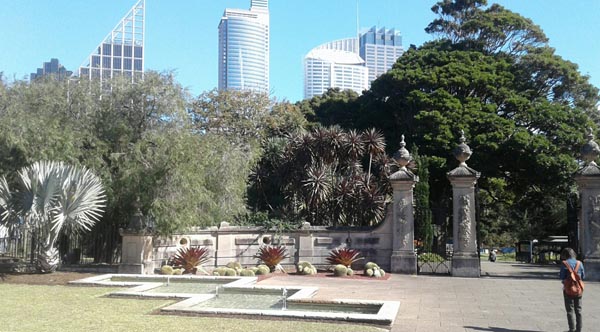
The entrance to the Royal Botanic Gardens Sydney

The Palm House

Inside the Palm House

Here are just a few images from the current exhibition. Having light coming in from three sides of the Palm House it is very difficult to photograph with the light reflected on the glass, but you can get an indication of what to expect at this exhibition.

Papaver nudicaule - Unfurling
Leda Turner
BEST IN SHOW

Telopea speciosissima and Acanthorhynchus
Janet Matthews
HIGHLY COMMENDED

Cynara scolymus
Sue Stuart
HIGHLY COMMENDED

Slipper Orchid
Gwenda Levy
HIGHLY COMMENDED


Some of the exhibited paintings

Every painting in the exhibition had merit and every person who exhibited needs to be congratulated on the standard of work they produced.

Monday, 25 January 2016

Eastern Spinebills on Banksia prionotes

Below is the second painting finished for the Sydney Royal Botanical Gardens Botanica exhibition, which focuses on Pollinators. It opens 9 April - 3 May. There is an incredibly long lead-in to this, as works have to be submitted for selection early February.

Eastern Spinebills on Banksia prionotes


Wednesday, 20 January 2016

New Paintings

It has been very difficult to find time to do my own work, as I have been extremely busy with travelling for work and a few holidays (absolutely deserved as I work seven days a week) and lots of workshops and art tours. Then of course there are my three Distance Learning Course in Botanical Art, Natural History and Travel Sketching.

Ideas spin around in my head and if only I had the luxury of months of painting.

Anyway, will share two of my finished pieces with you, which will be in Botanica 2016 in the Sydney Royal Botanic Gardens in April 2016.

When I was in New Zealand in December, I saw a Harakeke Red Flax (Phormium tenax). The colours were absolutely amazing, just glowing in the sunshine. The flax was also bursting with bees, eager for the ripe anthers.

While admiring the flowers, a New Holland Honeyeater flew down and landed on the flax. I thought "I just have to paint this" which is what I have done.


Initial washes


I will add the next painting on a new blog.

Saturday, 21 March 2015

Botanica Exhibition 'The Birds & The Bees'

I worked to strict deadlines to finish my paintings for this year's Botanica Exhibition at the Sydney Royal Botanic Gardens which will open to the public on 18th April.

The theme is The Birds and the Bees. This produces some spectacular paintings with an enormous variety of pollinators. Lots of fun to do and as an artist, I love the opportunity to explore and expand into other areas of botanical art and to work with more diverse subjects.

Below are my two submissions for this years exhibition.

I love the designs that nature creates, and when I first saw this extremely large Japanese Spider Chrysanthemum I fell in love with it. It definitely chose me. The pollinator bees also lend interest and scale to the flower.


Japanese Spider Chrysanthemum


I loved the design and colour elements on the Eastern Spinebill birds, and also the complexity of the feather arrangements. It was a very rewarding painting for me and I thrived on the research and information gathering that went into the work.
Boongala Spinebill Grevillea with Eastern Spinebill birds (male, female, juvenille)

Juvenille Eastern Spinebill


Sunday, 25 May 2014

'Botanica' Exhibition in Sydney

The Friday night opening of the annual 'Botanica' exhibition at the Sydney Royal Botanical Gardens was a great success.

It was the best 'Botanica' I have seen presented, for many reasons. The selection of paintings was extremely well balanced, although paintings by single artists I feel should be limited, to allow for others artists who are equally talented, to exhibit their works. 

The exhibition was beautifully curated by Judy Dunstan for the first time, and I look forward to seeing her in this role again next year. 

Another interesting and profound element was that there were no extravagently overpriced paintings. Most well priced paintings will sell, but with some artists insisting in previous years of pricing themselves out of the market, I think this point has hit home.

The general public is not aware of the 'names' in botanical art, and with so many wonderfully talented artists out there, it would be difficult to choose one artist over another. They are all extraordinary in their own right.

This is a wonderful exhibition, and I am sure it will sell extremely well. I look forward to visiting again at least twice (or more) as there is so much to take in. If you are going along, take note of the framing as well, which forms part of the overall presentation of the painting, and can 'make or break' some work.

Enjoy!!

With my painting of the Banksia menziesii and Banksia prionotes

Saturday, 8 March 2014

Natural History at the State Library

There is a fascinating exhibition currently on at the State Library of NSW - 'Artist Colony: Drawing Sydney's Nature' and it is on until 11 May 2014.

Over 100 natural history drawings and paintings from the late 18th century showcase this prolific exhibition.

It relates and reveals the colonial thirst for knowledge and our emerging cultural history. It is an incredible insight into the fascination the colonists discovered in the unique and exotic flora and fauna of Australia.

There are a total of six album volumes. Some of the work has been done by the colonial officers, others by convicts which would often be artists or counterfeiters.
 
There is an amazing history about the paintings, why, when, where and how they were done, and for what purpose.


I cannot recommend the State Library of NSW's website highly enough. The exhibitions and other collections are beautifully presented.
 
See http://www.sl.nsw.gov.au/events/exhibitions/2014/artist_colony/index.html. The website includes a film, images of the paintings including a facility for magnification of the exhibits, an interactive resource and other information pertaining to this exhibition.
 
Enjoy!!!!

Wednesday, 19 February 2014

More Paintings

I have been amazingly busy with painting, firstly for the upcoming Botanica Exhibition at the Sydney Royal Botanical Gardens. The work goes in for selection on 14th March, and the exhbition is open to the public 24 May-15 June. Below is a small preview of one of my paintings. As an artist I try to be innovative and love a challenge.
 
I have been on holidays over January so there has not been much time to complete a few more paintings to add to those I completed prior to Christmas.
 

I have this amazing Begonia growing on my balcony and it never seems to stop flowering and is usually a mass of colour. So what better subject? The background is in graphite and watercolour for the actual flower.


For this exhibition I have worked on mainly Australian natives, but other interesting subjects as well. For all lovers of Botanical Art, the Gardens exhibition should be something special, judging by the painting previews. There will be some very contemporary work there with lots of new artists exhibiting.
 
The other project I am just loving and working hard to my deadline - is a series of Australian native plants to be put on a porcelain dinner set.  There are six paintings in the set and to date I have finished the drawings, ready to transfer them on to the watercolour paper. Then head down to do the paintings. It is exciting work, and I love working to a theme.   More on this commission later.


Friday, 17 May 2013

Rory McEwen Botanical Artist

For many years I have been a great admirer of Rory McEwen, a botanical artist of great renown but also a gifted musician. He was born in Scotland on 12 March 1932 and in his short life produced some of the most amazing botanical art I have seen.
 
His single subjects, often of a single leaf, are vibrant with colour, extraordinary in their detail and almost ethereal in their presence.


I am often drawn to his book which I have had in my collection for as long as I can remember and am in awe as I open the pages to look in wonder at his paintings.
 
So you can imagine how excited I am that I will be going to London in August and will be able to see his wonderful exhibition of works 'The Colours of Reality' at the Shirley Sherwood Botanical Gallery at the Kew Botanical Gardens. His paintings can be described as 'hyper-realistic'.
 
I would like to share this video with you. His work remains a legacy to his devotion to art, his love of nature and his incredible creative talent. Sadly he passed away at age 50 on 16 October 1982.
 
 
If you are interested in finding out more about Rory and his life, there is (as always) a mountain of information on the internet.
 

Sunday, 7 April 2013

Botanica Exhibition

I have taken my 5 paintings into the Sydney Royal Botanic Gardens for their annual exhibition opening to the public on Saturday 13th April. This is Sydney's major botanical art exhibition.
 
I was very pleased with the framing which totally enhanced my two framed paintings. The Art Scene in West Ryde (Sydney) has as usual done superb work. I do not go anywhere else for framing, as  I have tried some local framers with very disappointing results. There is no comparison with exhibiting a painting with a custom frame, and that of a ready made (for the masses) frames.
 
I finished off three unframed paintings which can be sold together or separately, as they are A4 size, which is a size that is quick and easy to finish - although don't pack the punch of larger paintings, which make a real statement on the walls.
 
I have begun work on a large banksia painting, so will post some images of that soon.
 
Hakea baxteri (unframed)
 

Grevillea baxteri (unframed)


Thursday, 14 February 2013

Painting Finished

After working frantically for the past 5 days, my painting is finished and ready for selection for the Botanica exhibition.
 
When is a painting finished?
When you look at it and nothing jumps out at you.
If there is something not right, which may just be an inconsistency of tone, and you think "it wont matter, no one will notice". That is extactly the first thing people do notice, as it would be bothering them as well.
 
When you have made some adjustments and know there is nothing else to do to make it any better.
I like to leave it for a day or so, and not be in such close contact with the painting. Then look at it with fresh eyes.


It is interesting just how much you can get done when you are not doing anything else!!! I worked on other projects early morning and until quite late at night, just to be able to paint in the day.
 
Now to put this project to bed, and perhaps even relax for a while.


Wednesday, 13 February 2013

Strelitzia reginae

The selection deadline looms for the Botanica exhibition at the Sydney Royal Botanic Gardens. In fact, it is on this Saturday.
 
Since returning from overseas, work has been hectic, but I had an urge to do another painting for the exhibtion. While in Mt. Tambourine, Qld last year I collected an incredible dying Strelitzia reginae specimen. The gnarly, dried flowers and sepals form a twisting web of movement. This is what attracted me.
 
I did the initial drawing and colour study on Sunday, then began painting on Monday. Work has progressed really well and I am excited about the progress. Not finished yet, but here are a few stages of the process.
 
The flowers and sepals
 
 
Seed pods and seeds

 
I hope to finish this painting today. More washes and focus on tone. But before I do that, must do assessments on my External Students assignments.........


Thursday, 22 November 2012

Botanical Art in Melbourne

Melbourne is Sydney's sister city, and like so many sisters, is different in so many ways. The entire feeling surrounding Melbourne is totally cosmopolitan, extemely cultural and very laid back. I love Melbourne and thrived on the atmosphere and incredible weather in the three days I spent there.

Melbourne on the Yarra River
 
Some of the laneway graffiti street art Mebour is famous for

Sydney is my town, very rush and bustle, very much a lady, always adorned in its city attire. We have a sense of the outdoor eating culture, but in a very different way to Melbourne. We are not so laid back, more a sense of everyone always in a hurry - and I am no exception. Its difference is also its charm and I would not choose to live anywhere else.
 
The purpose of my visit was to see two major botanical exhibitions. One was the 11th Biennial Exhibition The Art of Botanical Illustration 2012 in Domain House, situated in the Melbourne Botanical Gardens. 145 beautiful works were displayed.
 
Would have loved to have spent more time browsing, chatting to other artists and in general, catching up with the Melbourne ladies of botanical art. Spent time talking to the lovely Sandra Sanger who is an extraordinary artist and had three amazing paintings on display. My favourite painting in the show was her Haemanthus coccineus, excuted in watercolour and graphite. So amazing in its incredible detail.


Sandra Sanger's watercolour and graphite painting Haemanthus coccineus
 
All art is subjective and botanical art is no exception. The general public do not always understand what goes in to making a botanical painting. The initial research of the plant, the many, many hours working with fine detail, correct representation of plant and colour, but also the personal satisfaction and reward are worth it all.
 
We do not paint botanially for the money, as if we counted the hours involved the paintings would be priced right out of the market. A beautiful painting by an experienced and  gifted artist is really a bargain at $2500 or even $3000. The public does not always see it that way.
 
I am probably coming from a different place than most people. I love the detail, I love the composition and artistic interpretation and I appreciate every brush stroke and every hour that constitutes a work of art.
 
Generally the average buyer looks for something that "goes with their colour scheme" or "fits into the space in the hallway". These purchases are chosen because the buyer has fallen in love with them, whether they are technically correct or not. For every painting there is someone who will love it. And that is what art is all about.
 
The following day I took the train to the historic town of Ballarat in Victoria, an hour and a half from Melbourne. It is Victoria's third largest city, former gold mining town and has a rich and living heritage. Ballarat is famous for the Eureka Rebellion and many paintings of this event can be found in the Ballarat Regional Gallary. The goldfield workers opposed the governments miners' licences and the rebellion was instrumental in the development of Australian democracy.
 
 Ballarat Railway Station

 
"We swear by the Southern Cross to stand truly by each other and fight to defend our rights and liberties"  Eureka Oath, November 1854.
 
I am a bit of an Australian history buff and retain a very strong connection to my heritage and Australia's past, including all things architectural.
 
Ballarat Regional Gallery held a remarkable exhibition showcasing their collection of both colonial and contemporary botanical art Capturing Flora: 300 years of Australian Botanical Art. There were over 300 images, from hand painted engravings from the 19th century to original current paintings. As you move from room to room, you move from the very early works to the very modern.
 
There was far too much to take at once, so we absorbed as much as we could, went out of a coffee and a chance to talk about what we had seen, before embarking on another section of the exhibtion.


Da Vinci cafe in Ballarat with incredible wall paintings
 
 
Some visuals will enlighten you as to the work that was displayed.


 Melaleuca hippericifolia (Melaleuque a f.lles de Millepertius)
Engraver Gabriel Sculp c1807
Hand coloured engraving
 
Drawings were made from early voyages of discovery, as well as the plants being collected, recorded and mounted. These were later drawn by often unknown artists, engraved, then coloured.


 Clianthus dampieri (Nouvelle Holland)
Unknown artist, published Belgium 1858.  Lithograph from 'Illustration horticole, jurnal special et des serres et des jardins'
 
William Dampier (1651-1715) was a great explorer and the first Englishman to explore areas of Australia, then known as New Holland. He and his crew of the Roebuck landed in South Australia where the Desert Peas were in full flower. They collected and dried the specimens, which were later illustrated in Dampier's book A Voyage to New Holland in 1703. The original specimen is still held at Oxford University.
 

 Dryandra pteridifolia
Unknown artist UK c1836. Hand coloured engraving
 
I am currently painting a Dryandra and have done previous paintings of them in the past, while doing commission works from the plants collected by William Baxter. So the connection to this painting was very personal. William Baxter (died c.1836) was a prolific English plant and seed collector and in 1823 he collected seeds from south-eastern Australia, around the Albany area, which is a dry, windy region of Western Australia, but incredibly rich in many varieties of Australian native plants.
 
There was often a very long journey from the initial drawing or collection of plants to publication in the 18th and 19th centuries. From the discovery of the plant, to the drawing then the often hand engraving to the hand painting. The engravings were invaluable for reproducing books. Unfortunately, many of these books have been cut up and the hand coloured engravings sold separately for incredble amounts of money. Fortunately Ballarat Gallary has some of the books still intact.